Learn Vietnamese tones
Six marks, six melodies. ma, mà, má,
mả, mã, mạ are six different words, and the only thing
separating them is what your voice does over one syllable.
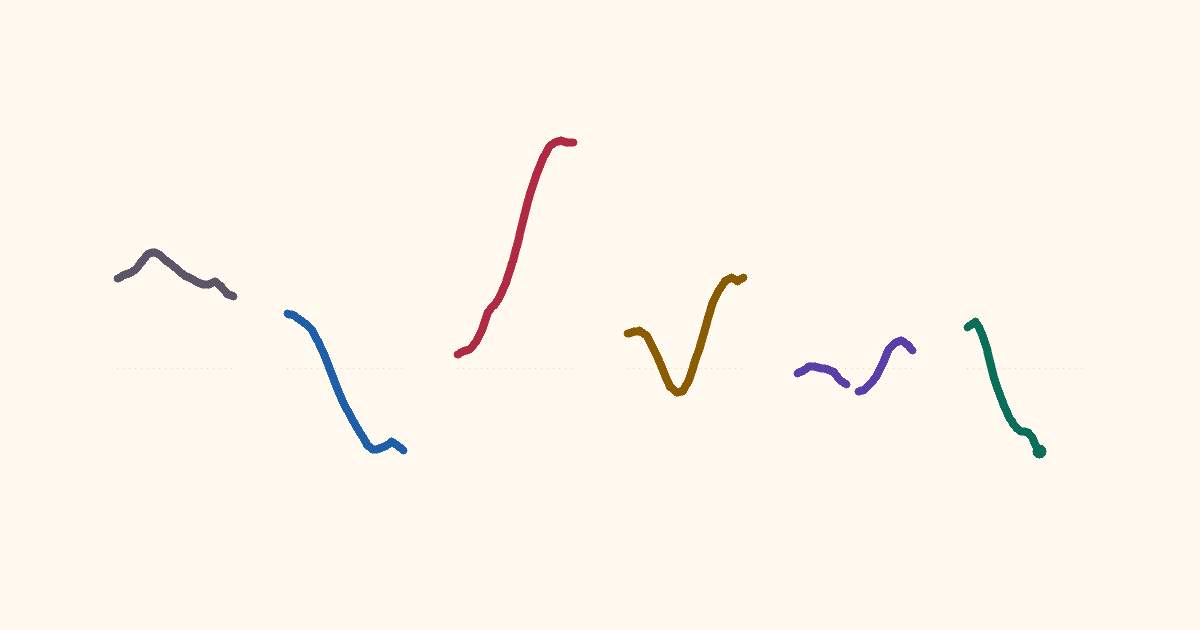
The six tones
| Mark | Name | What the voice does | Measured on |
|---|---|---|---|
| a | ngang | level, in the middle | 486 |
| à | huyền | low and falling | 457 |
| á | sắc | rising and tense | 191 |
| ả | hỏi | dips, then comes back up | 150 |
| ã | ngã | rises, broken in the middle | 145 |
| ạ | nặng | low, short, cut off | 410 |
The right-hand column is not decoration: it is how many native recordings each contour was averaged from.
Hearing them is not the hard part
Most learners can tell má from mà after a week. What takes months
is producing them — and the reason is simple: you cannot hear your own pitch while you
speak. Your skull conducts sound differently than air does, and your attention is on the words.
So you repeat after a recording, it sounds right to you, and it is wrong. Nothing tells you which way it was wrong, or by how much. That gap is where most people quit.
The fix is to see it. Say the syllable, and the app draws your pitch over the native curve. A gap of two semitones is visible; the same gap is inaudible to the person who produced it.
Six tones, or five?
It depends on where you are. Northern Vietnamese distinguishes all six. Southern Vietnamese has five: hỏi and ngã merge into one, and the glottal break of ngã disappears. Neither is more correct — they are two accents of one language, and roughly forty million people speak each.
This matters on day one, not later: if you learn both realizations of the same letter, you carry two systems in your head for the five hardest sounds. Pick one. The app asks you at the start, and lets you change your mind.
The hardest contrast
ngã against hỏi is the one that takes longest for every non-native speaker. Both start by falling. One comes back up smoothly; the other comes back up through a break in the voice — a catch, like the start of a cough. There is a whole page on that one.
Where to start
Not with the tones. With the vowels — because a tone rides on a vowel, and a French or English speaker glides their vowels without noticing. A gliding vowel makes every tone on top of it unreadable.
Start chapter 1 — the vowels202 chapters, free, and the whole thing works offline.